What is a Geomembrane?
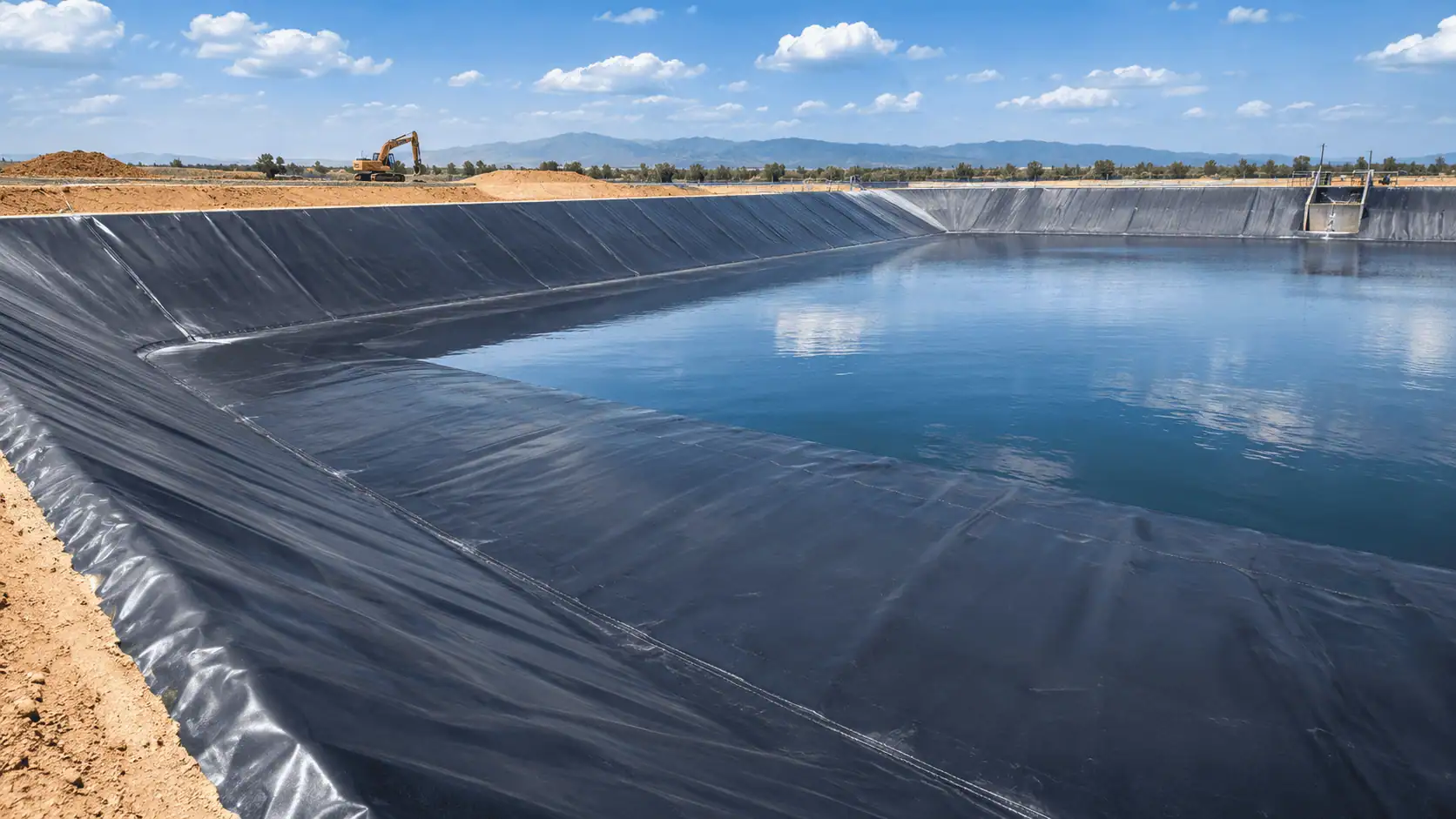
A geomembrane is an engineered polymer composite, an essentially impermeable synthetic liner manufactured as a sheet or reinforced membrane. Its function is simple to state but difficult to execute, form a continuous barrier that keeps contained material in while keeping surrounding groundwater, soil, and gases out.
“Essentially impermeable” is the operative phrase. No material is perfectly impermeable, but a properly formulated and installed geomembrane has a permeability several orders of magnitude lower than compacted clay, and, most critically, it is verifiable. Field seams can be tested non-destructively. Panel layouts can be documented. Compacted clay liners, by contrast, depend on consistent moisture content and compaction across an entire footprint, and their as-built performance is far harder to confirm.
That verifiability is why geomembranes are the default barrier for regulated containment, and why most modern specifications call for one either alone or as the primary component of a composite liner system.
The main types of geomembranes
Geomembranes are classified by base polymer. Each family offers different characteristics for flexibility, chemical resistance, UV durability, and installation cost.
HDPE (high-density polyethylene)
The workhorse for landfill and mining containment, HDPE offers excellent chemical resistance across a broad range of leachates and hydrocarbons, high tensile strength, and strong UV performance. The trade-off is its stiffness. HDPE is comparatively unforgiving for irregular subgrade and differential settlement, requires thermal welding by trained crews, and is prone to stress cracking if detailed poorly. It is best suited to large, relatively flat installations where chemical resistance is the governing requirement.
LLDPE (linear low-density polyethylene)
LLDPE trades some of HDPE’s rigidity for significantly greater flexibility and elongation. That makes it the better choice where the liner must conform to irregular contours, accommodate settlement, or wrap complex geometry. It also delivers higher puncture resistance at comparable thickness.
Reinforced grades add a scrim between plies, which raises tear and puncture resistance and improves dimensional stability, making it useful on side slopes and in exposed applications.
EIA (Ethylene Interpolymer Alloy)
EIA is a flexible alloy membrane built on DuPont Elvaloy resin technology. It combines the chemical stability of a polyethylene backbone with markedly better flexibility and longer UV resistance than HDPE, which makes it a strong candidate for exposed, above-grade installations and for hydrocarbon-rich service.
EIA is typically supplied in layered configurations: a single-ply non-reinforced sheet, a two-ply construction bonded to a geotextile, or a three-ply composite with reinforcement fully encapsulated inside the membrane so the scrim never contacts the contained product.
RPE (LLDPE-R) (reinforced polyethylene)
RPE is a polyethylene sheet with a reinforcing scrim laminated between plies. The scrim carries tensile load, which lets an RPE liner deliver high strength and tear propagation resistance at a lower weight and thinner gauge than an equivalent unreinforced sheet. Lighter panels are easier to handle, and RPE is commonly supplied as large factory-prefabricated panels, which can be a real advantage. Fewer field seams mean fewer field variables, and field seams are where liners often fail.
It’s worth being precise here, because the terms get used loosely in the market: RPE is reinforced polyethylene. EIA is a different resin chemistry entirely. Both are available in reinforced constructions, but they are not interchangeable, and a spec that says “RPE/EIA” as though they were one material will cause problems at submittal review.
PVC (polyvinyl chloride)
Highly flexible, economical, and easy to fabricate into large, prefabricated panels, PVC seams readily and conforms well to irregular subgrades. Its limitation is long-term exposed performance. Plasticizer migration degrades PVC faster than EIA or polyethylene under sustained UV, so it is generally specified for buried or covered service.
Key properties to compare
When you put candidate materials side by side, the specifications that matter are:
- Permeability. The baseline barrier metric.
- Chemical resistance. Not in general terms, but against your stored product at your service temperature. Always request a chemical resistance chart and confirm compatibility for the specific chemistry.
- UV and weathering resistance. Governs service life in exposed installations. Buried liners are far less sensitive.
- Elongation. How much the sheet can strain before failure. This is the property that determines whether a liner survives differential settlement.
- Puncture and tear strength. Drives subgrade preparation requirements and whether a protective cushion geotextile is needed.
- Seam method and quality. Thermal weld, chemical weld, or factory prefabrication. Field seams are where liners typically fail; minimize and test them.
- Regulatory certification. Potable water contact requires NSF certification. Aquaculture requires grades certified safe for direct contact with aquatic life. Federally funded projects may require Build America, Buy America (BABA) compliance.
Common applications
Geomembranes appear across essentially every sector that stores or isolates liquid:
- Potable water storage: municipal reservoirs, storage tanks, and treatment facilities
- Wastewater and lagoons: municipal and industrial treatment, process water
- Oil and gas secondary containment: tank farms, berms, pads, and frac ponds
- Floating covers: evaporation control, water quality protection, and odor containment on open reservoirs
- Aquaculture and fish hatcheries: ponds and raceways requiring fish-safe liner grades
- Stormwater and environmental protection: retention basins, capping, and remediation
- Transportation and construction: subgrade barriers and roadway applications
How to choose the right geomembrane for your project
Material selection resolves quickly once you answer three things in order.
- What are you containing? Chemistry drives the polymer chosen more than any other factor. Potable water, hydrocarbons, high-pH process water, and aquaculture each point toward different formulations and toward different certifications.
- What are the site conditions? Subgrade quality, slope angles, anticipated settlement, temperature range, and whether the liner will be exposed or covered. Irregular terrain and settlement push you toward flexible materials. Long-term exposure pushes you toward UV-stable ones.
- What service life and regulations apply? A 1 – 10-year temporary containment and a 30-year municipal reservoir are different specifications. Regulatory requirements like NSF, BABA, state environmental rules often constrain the field before performance criteria do.
The above answers will point you to a proper polymer, thickness, and reinforcement configuration. Everything after that is detailed.
The most common and most expensive mistake made is treating material selection as a procurement decision made late in the project. It is better to involve a geomembrane manufacturer during design. A specification conversation that takes an hour up front routinely prevents failures that cost six figures to remediate after installation.
Where E Squared fits
E Squared Geomembranes manufactures four product families, each engineered for a distinct service profile:
- PVC
- EIA (ERCoat®) — Ethylene Interpolymer Alloy built on DuPont Elvaloy technology, available in single-ply, two-ply, and three-ply encapsulated-reinforcement configurations. Engineered for potable water, hydrocarbon containment, and demanding exposed applications. Available in NSF-certified configurations for potable water contact.
- LLDPE-R and LLDPE-R FG (FlexLiner) — reinforced linear low-density polyethylene for general containment, plus a Fish Grade variant certified for direct contact with aquatic life in hatchery and aquaculture service.
- Mirage — a high-albedo floating cover membrane that reflects solar radiation rather than absorbing it, reducing evaporation loss and holding water temperatures down on open reservoirs.
E Squared is a member of IGS North America and the Geosynthetic Materials Association, with products certified through NSF and the Australian Water Quality Centre, and BABA-compliant options for federally funded work.
Frequently asked questions
What is a geomembrane made of? Geomembranes are manufactured from polymer sheet, most commonly high-density polyethylene (HDPE), linear low-density polyethylene (LLDPE), Ethylene Interpolymer Alloy (EIA), or polyvinyl chloride (PVC). The base polymer determines chemical resistance, flexibility, and UV performance.
How long does a geomembrane last? Service life depends on polymer, thickness, and exposure. Buried or covered installations commonly reach 20–50 years or more. Exposed installations (up to 30 years) depend heavily on UV stabilization; burial or covering extends service life substantially in every material family.
What is the difference between a geomembrane and a geotextile? A geomembrane is an impermeable barrier that blocks liquid movement. A geotextile is a permeable fabric used for separation, filtration, drainage, and puncture protection. They are frequently used together, where a geotextile cushion beneath a geomembrane is standard practice on aggressive subgrades.
What thickness of geomembrane do I need? Thickness is driven by subgrade condition, hydraulic head, exposure, and regulatory minimums, and typically ranges from 30 to 60 mil for most containment work. Confirm against the governing specification and the manufacturer’s data sheets.
Next steps
Working through a containment spec? Review our product data sheets and drop-in specifications, explore how our products perform across potable water, secondary containment, wastewater containment, fish hatcheries, and floating covers, or contact our application specialists to review your project requirements directly.